What is Responsible AI Use?
In the latest Tepperspectives Video, Tepper School researchers Taya Cohen and Sofía Rodríguez Chaves look at how ethics and moral character influence responsible AI use in the absence of policy or regulations.


Tepper School doctoral student Pim Assavabhokhin speaks with Professor Emily DeJeu about how AI can enhance short-term decision accuracy and transactive memory systems to improve team speed, but over-reliance on technology can create a dependency.
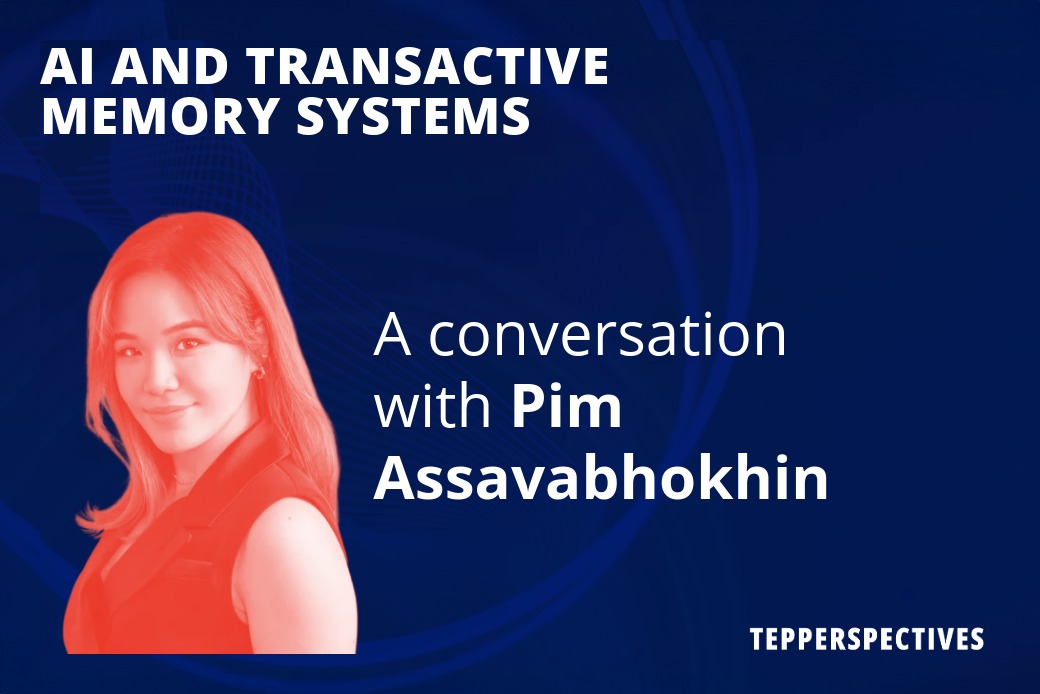
Pim Assavabhokhin is a third-year Ph.D. student in Organizational Behavior and Theory at the Tepper School of Business at Carnegie Mellon University. Working with Professor Linda Argote and Professor Catherine Shea, her research examines human AI teaming, focusing on how AI systems help teams maintain and coordinate knowledge when transactive memory systems, or the shared understanding of who knows what, are strong, as well as when they break down. She conducts both laboratory and field experiments to understand how AI can support learning, performance, and knowledge continuity in teams. In a related stream of research, Pim investigates how AI reshapes advice seeking and impression management at work, drawing on network theory to examine whether seeking advice from colleagues undermines perceptions of competence and whether AI can serve as a private alternative that preserves access to information without incurring reputational costs.

In the latest Tepperspectives Video, Tepper School researchers Taya Cohen and Sofía Rodríguez Chaves look at how ethics and moral character influence responsible AI use in the absence of policy or regulations.

Tepper School researchers introduce Accounting Classification Entropy, a novel measure derived from information theory that quantifies the structural information in corporate financial reports, which is proven to be significantly associated with stock returns, trading volumes, and financial analysts' resource allocation.

Tepper School faculty members Emily DeJeu and Brandy Aven discuss the future of artificial intelligence in the world of work.